Graphic recording is a highly effective visual method
Graphic recording (or visual recording) is a highly effective visual method for documenting discussions, presentations or workshops in real time using drawings. Graphic recorders create visual protocols of events using images, symbols and texts simultaneously with the spoken word.
In this way, the core messages of your event are documented and put into graphically comprehensible contexts.

Added value of visualization for the participants of an event

Understanding and memory
Graphic recording supplements the linguistic processing of the left hemisphere of the brain with visual-spatial processes of the right hemisphere. Facts and images are interlinked in perception, thus they are internalized more strongly and understood more deeply.
Inspiration and motivation
Following the creative process activates the participants. They interact with each other and enter into a relationship.
The emotional and sometimes humorous presentation can also bring sensitive nuances to light, opening up new possibilities for exchange.


Clarity
The illustrator systematizes the content for the participants and reduces the information to the essentials. This is the special requirement of graphic recording, which is why a very high degree of concentration is necessary. The result is clear and structured, and the clarity makes it easier to access the information.
Creativity and new perspectives
Graphic recorders bring in new perspectives. The external view of topics can provide valuable impetus. Pictorial metaphors and symbols work, communicate in many different ways and can thus help to enable “thinking out of the box”. Scope is freed up!

In which situations can graphic recording be used?
The method is particularly suitable for the following event formats:
Graphic recording is suitable for all subject areas, but the following are particularly suitable:

What are the advantages of graphic recording?
Graphic recording (or visual recording) creates thematic clarity and makes it easy to grasp the content of the event. The information and objectives of the event are thus remembered for a long time and outsiders can also immerse themselves in the topics afterwards using the image.
Graphic recording promotes creativity and engagement during the event – for all participants.
The reason for this is that a handmade picture, created in front of everyone’s eyes, always passes on lively impulses to the group. People react very positively when they see the themes of their working world transformed into this kind of info-art. Interwoven with humor and unconventional perspectives from the outside, the informative images become firmly anchored in people’s minds.


What effect does graphic recording have on the participants of an event?
The participants listen to the discourse and can observe live how a visual landscape is created that collects the knowledge manifesting itself in the space. We live in turbulent times, people want to feel adressed. Visualization creates Clarity and Connection.
With analogue graphic recordings, which are also visible in the room during the breaks of an event, participants like to pick up on the visualized topics to get into conversation with each other. Photos are taken and shared on social media.
Afterwards, the organizers can use a digital version of the graphic recording for follow-up communication, e.g. in emails or social media posts, or as documentation on their own website.
Analog Graphic Recording


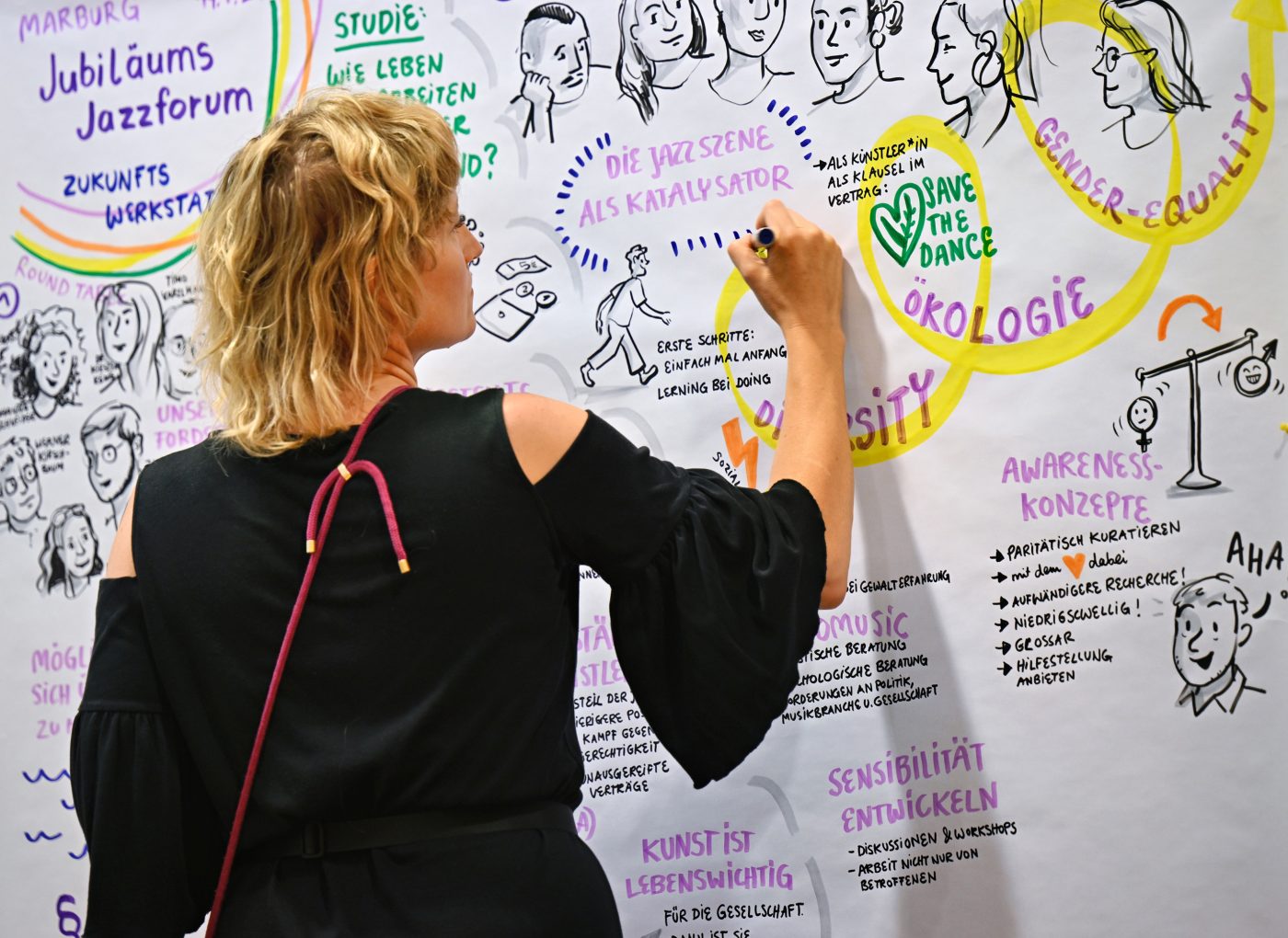
Foto: © Agentur Papagei / Brandenburger Innovationspreis 2025
There are various methods of implementation – depending on the conditions on site and the objective of the event. Analog work with markers and/or chalks on large-format paper or boards enables the participants of the event to look directly over the draughtsperson’s shoulder and experience the creation of the image live. The originals and a digital version of the graphic recording will be made available to the client after the event.
Advantages:

Highly recommended!
At our PSP Conference 2022, representatives from science and industry presented sustainable technologies of the future under the motto “Biotechnology & Bioeconomy – Pathways to the Future.”
Miriam Barton did a fantastic job of documenting our sessions and summarizing the highlights, even when dealing with complex scientific topics. Highly recommended!

Digital Graphic Recording


Digital graphic recording is drawn using an iPad and pen. It can be continuously transferred to a screen during the event or displayed at desired times during the agenda, e.g. during breaks or at the end. It is also possible to play out the creation process as a time-lapse film and process it into an animated explainer.
Advantages:

Impressively to the point
Miriam Barton’s graphic recording impressively summed up our complex topic of scientific trust and media impact. With great clarity and sensitivity, she translated the discussions and content of our workshop into concise, visual images: a real enrichment for our work. What was particularly nice was that her illustrations had an impact far beyond the event itself and became part of an exhibition on the topic of trust at our research institute in Karlsruhe. An inspiring and professional collaboration!

Remote Graphic Recording


The visual accompaniment of an online event is also possible. This has been done frequently during the pandemic. The graphic recorder does not travel to your event in person, but joins in via video conference and draws digitally on the iPad. The image can be transmitted live whenever desired. It is also possible to create a graphic recording afterwards if you can provide good documentation or a video recording of the event.
Advantages:

Incredibly quick on the uptake
I have worked with Miriam Barton in various contexts and it has always been a great experience. Her graphic recording work at the digital closing conference of the project Democracy? A question of constitution! by WIR MACHEN DAS impressed me and all my colleagues greatly. Miriam has an incredible ability to grasp concepts and lovingly translated the sometimes difficult content into visuals. In addition, her open and friendly nature is an absolute plus!
